


This post follows Jandalf’s Question (Part 1).
An acrid smell filled my nostrils, and a chemical bitterness coated my mouth. A harrowing wail pierced through all the smoke. Perhaps this was an air raid - a bombardemint d'avions, as the local Walloons would have called it during WWII.
But today I was fortunate. There were no Luftwaffe pilots flying overhead, no 500kg bombs plummeting to the ground, no buildings billowing black smoke. The flares and sirens merely signalled the start of a quaint little foot race, the Legends Trail 350.
The race my Achilles would not allow me to complete, meaning my nightmare scenario was all dialled in: my first DNF, and a concomitant existential crisis.
So when I smiled for the camera, my face contorted unconvincingly, as if I’d spotted a supporter brandishing a sign “Almost there - only 350km to go!”
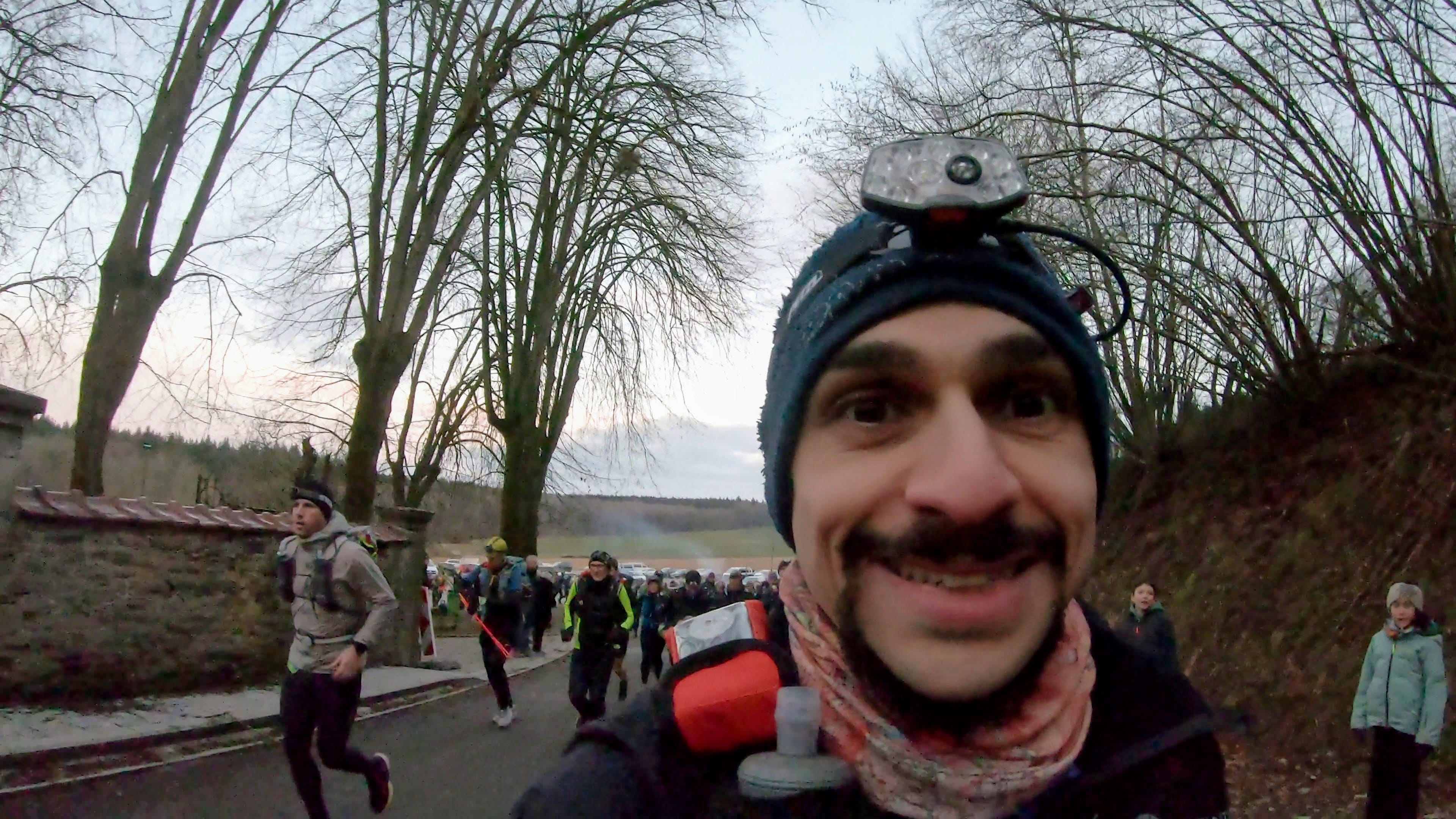
It took a minute to escape the crowds, for the wailing of the siren to subside, to finally break out onto trails. For my focus to shift back to my buggered Achilles. Though, oddly enough, that felt as though it might be loosening off.
It was; and as it continued to relax, my gait began to flow naturally, my stride opened up, and I found myself flying, euphorically, down this fantastic footpath toward freedom.
After 6 weeks of relentless, Achilles-triggered plantar fasciitis, I knew this respite in my condition could only be temporary, and that I ought to exercise caution - but I simply couldn’t help myself. I leaned into the descents, relishing every leg swing, every foot-strike, my chains of muscles firing in choreograped perfection. My mind was left free to wander the trails and trees, melding with this slice of paradise in the Ardennes.
I was only five minutes into this race, yet I was already experiencing an awakening so profound that it had taken 250 miles to form during my last Spine race: that self-transcendent, wu wei flow-state. An experience so completely ineffable that to describe it would require the transplanting of minds. A feeling of infinite, effortless flow; of presence, of being.
Back in the race, I was in the lead, putting distance between the pack and I. Disappearing into the woods, into the clouds, into the milkiest of ways.
How ridiculous was this? Just minutes ago, I was an injured runner, hobbling, about to DNF, or DNS. And now; a liberated soul, rocketing from clouds eight to ten.
These early kilometres of freedom coasted along on invisible updraughts. I relished every moment, living each second as if it were my last. Yet none of it felt entirely real, as if I were living a dream wending its improbable path through superficially lifelike situations.
Now the path was warping and kinking. The hills steeper. The trail wetter, muddier, stickier. And it may have been with the advent of the mud and the climbs that my Achilles stiffened, and the dreaded heel pain returned.
My pace slowed as my devastating limp began to reassert itself. That dreamy wu wei flow state floated away up into the clouds, leaving me with nothing but the cold, concrete reality of my knackered Achilles heel.
A fortnight ago while running Peddars Way Ultra, I’d suffered a similar, though less profound experience. My strong start abruptly degraded into a debilitating hobble, such that I struggled to finish what was a completely straightforward 80km ultra. So I could well guess what was about to occur now.
First, my quads would overload and burn out. Then the real rout would set in: hip flexors, calves, the works. This was, sadly, the beginning of the end.
My pace dropped further, and then the first runner overtook me. And then the next - but; hey, this was Jandalf the Savage, and he drew alongside for a chat.
Jandalf was in high spirits, and I tried hard to match his mood. After all, my early kilometres of free-flowing freedom had been such an unexpected bonus. Could I not celebrate that gift, rather than bemoan its loss?
But with the continually worsening pain in my heel I struggled to match Jandalf’s pace, and could only watch him glide off into the distance. He looked every bit as sharp and serious a podium contender as his physical and mental preparation suggested.
I paused at the next wooden sign to stretch my right calf, taking a moment to reflect - and reset. Of course, I had fully expected this would happen. But based on my experience at Peddars Way, I’d expected it after 20km or so. Not after just five.
A fog of despondency set in as runner after runner shot past me. There went Atomic Barista - and I should have wished him well, but I remained silent, for I no longer felt capable of speaking with a positive disposition.
The terrain deepened, with denser forests and steeper folds of hill and valley that evoked fond memories of Wendover Woods. I rode the waves, each one a more demanding climb, while evening gave way to a pitch black night. My headtorch went on, and with it, that familiarly unfamiliar world revealed itself.
As if slipping back into my favourite book, I revelled in one of my most bewitching pleasures of ultrarunning. Trails of headtorches wending their zig-zag paths up and down the hillsides. No matter how many times I experience this spectacle, it never fails to trigger in me the broadest and most satisfying of smiles.
Each dot is a fellow soul. While we each endure separately, trapped within our bubbles of consciousness, our dots combine over a hillside to render an image far greater than the sum of its parts. An image made possible only because we share a common struggle, what South Africans call Ubuntu.
Cutting through the silence of the night, the rhythmic sound of my feet, squelching through mud. Occasional swishes as my face brushes past needled branches. My olfactory senses bathing in the fresh balm of pines and spruces.
I would readily have diffused into this forest air, but the pain in my Achilles kept dragging me back to my mental bubble. My mortal battle. My Troy.
After 18km I was released into a sleepy Ardennes town. I hobbled past volunteers manning an unexpected water stop, and did a double-take. Water stops between checkpoints? Nobody had mentioned that, so I’d hauled 2 litres of water this far for no reason.
A slippery, muddy descent ended at a shallow river. At a mere 6 inches in depth this couldn’t count as a ford. But it was enough to trigger a reflection: this race had so far introduced itself incredibly gently. Thinking back to the hints my friends had dropped at our hotel in Liège, what I’d experienced so far could only be the prelude.
The track that led out of the valley was to be the longest climb yet, finally popping out of the claustrophobic forest onto a lightly snowed-over hilltop. Here, the GPS route left the track behind, plotting an anonymous course across a winter wasteland of frosted twigs and branches.
At the extent of the clearing it wasn’t clear where to go, but some jostling through pine trees revealed a tunnel of a trail cocooned deep within the dense maze of trunks and branches. I hobbled along it, wending my way through towering pines, squelching through mud and splashing through water.
A 3km descent through these dark, whimsical woods proceeded uneventfully. But little did I know, I was dropping down to the Aisne river through the Manhay-Érezée sector, along the very line where one of the most decisive battles of WWII unfolded. On this northern front of the Battle of the Bulge, American infantry forces had defeated Hitler’s 2nd SS Panzer Division - curtailing his Western Front advance, and paving the way for Allied victory.
80 years ago, this region would have been unrecognisable. An unimaginable hellscape of exploding mines, anti-tank and artillery fire, entrenched dugouts, and close-quarters combat, supported by brave acts of sabotage undertaken by an army of local guerrilla resistance fighters called the Maquis. It all went down during the coldest European winter for 40 years. A million men, enduring a -10 to -15C freeze, hemmed in by deep snow and ice, hunkering down under barrages of bullets, bombs and shellfire.
It was on this very hillside - the Bois de Pays down to the Aisne - where almost 50,000 of those souls had fought. So many lives cut short; so much irreconcilable evil perpetrated, all because of the demented psychopathy of the 20th century’s most notorious far-right fascist.
I crossed the Aisne, up and over Betaumont - the “beautiful hill”, a high vantage point used by the Americans as a lookout during the war - and at 35km, I dropped down into the sleepy town of Dochamps. Here, I did another double-take as I hobbled past the second volunteer-manned water stop of the race.
I wrestled with the knowledge that I ought to appreciate the luxury of these unexpected hydration points, but I couldn’t help feeling a little frustrated. I was doing terrible damage to my Achilles, exacerbated by the 2kg of water I was hauling - entirely unnecessarily.
Perhaps there would be water stops every 15-20km along the route. Or, perhaps, like the Spine, these few special treats before the first checkpoint were just here to ease us in. To lure us into a false sense of security, and then no more. Who knew? Probably anyone who’d actually taken the time to read the race literature…
At the peak of the next climb, my headtorch beam bounced off a reflective warning sign nestled in-between clusters of snowy pine trees. I interpreted the French as “no entry”, with an exception for “travaux et DNF” - which sounded to me like works and forestry. My alternative translation was that it warmly welcomed runners planning to DNF, which would have been quite helpful if true. So I went with that.
I was well off-trail now, deep in the depths of this dark, towering pine forest. A fast and furious descent lay ahead, through which I launched over fallen tree trunks and slid down moist pine debris, furiously zig-zagging to track the route amidst flaky GPS under the dense tree canopy.
My exploration of this land of dark mysteries proceeded with a growing sense of intrigue. Where I was at any given moment, I hadn’t a clue. My only truth came from the information my senses fed me. A deep roar from vast rivers unseen. Crescendos of high-pitched babbling when streams popped out of the darkness. The cold rush of water as it filled my shoes and washed around my waterproof socks.
I welcomed these streams, because the cold sensation numbed the pain in my heel. Brief respites aside, my Achilles had worsened over the last few kilometres. To compensate, I was overpronating ever more, which was overloading my left quad and right glute.
Concerned over where these muscular imbalances were heading, I slowed my pace further, hoping that moderation now would allow me to progress further later. I calculated I was only couple of hours away from CP1. I’d certainly make it there...
But with each descent into the valley, my couple of hours estimate felt ever more optimistic. The route was becoming genuinely tricky now. Off-piste, over trees, over streams, wading up one tributary of the Ourthe river after another.
I only had two pairs of spare waterproof socks to ration over the whole race. Was it worth investing my time rock-hopping, scrambling along its sheer banks, to limit the time my feet spent underwater? But it felt as though my socks might already be failing and filling with water…
My sour mood reminded me of Ultra Damo’s mantra: “Bad mood? Food!” So I dutifully dug more marzipan out of my vest. Yet as delectable as marzipan is atop a Christmas cake, which those soldiers fighting on the frozen frontlines of the Battle of the Bulge could only have dreamed of; as my sole source of nutrition for Legends, the marzipan was starting to taste less like a treat, and more like a test.
After the briefest of respites passing through the hamlet of Borzée, the route returned to its familiar pattern: hustling along a river, climbing steeply up a hillside, dropping straight back down into the valley; rinse and repeat, rinse and repeat. Why did we keep climbing up, only to drop straight back down to the same damn river? Why did we keep dropping down, only to clamber back up to the same damn ridge? Through river wading and squelching, my search for answers, and a decent trail, continued.
My search was rewarded at Le Cheslé: a rocky spur that could have been lifted straight out of the eastern Peak District. I forgot all about my muscular predicament, drinking in every second along this beautful trail like an alcoholic at a beer festival. Each step contained that perfect balance of technicality and comfort; that duality of problem-solving and relaxation. Of meditative engagement. Flow-state.
I willed this wonderful experience to continue, while accepting it wouldn’t. Right on cue, one sharp descent led me back down to the Ourthe, and the slow-motion cyclical nightmare of wading and climbing resumed. I glanced down at my Garmin as a 17-minute kilometre registered on its face, and recalculated the time remaining to CP1. In distance terms, it was just a few kilometres away; but given the terrain, that would easily take three-quarters of an hour to cover.
With every climb, loop-back, rock-hop, and wade, my Achilles signalled that it was done. So this was it, then. CP1 was where I should depart the race, registering my first ever DNF.
I’d run one-sixth of the distance, and gotten a really good feel for the course. Enough to draw a fair comparison between Legends and Spine, to answer Jandalf’s question.
Then I could return to the important task of repairing and rebuilding my Achilles. After all, I was registered for the Summer Spine in only a few months’ time. I didn’t want to jeopardise that, just to say I’d hobbled on a little further.
But as logical as DNF’ing here obviously was, I was starting to feel the same feeling I’d felt many times before, every time I’d tried to DNF. That feeling of hopeless, helpless, inevitability.
And I could start to see the flawed logic of my Legends tragedy starting to play out. I would DNF before CP3… would I?
Did Achilles march on Troy because he’d weighed all his options, and decided that war was the most logical, rational and wisest course of action? No - he rode into battle because his emotions overrode logic.
That couldn’t happen to me. I make my decisions based on logical determination. Don’t I?
While I trudged my bedraggled, painful hobble the last couple of kilometres to CP1, Achilles’ timeless battle over logic and emotion played irreconcilably on my mind.
Continue reading Overlooking the Ghost Front (Part 3).