


It was over a cup of stinging nettle tea that Jandalf the Savage floated the question. Which race did I think was tougher: Spine, or Legends?
As a two-time Spine veteran, I felt I had a pretty good understanding of the race. Simply put, the Winter Spine is one of the toughest races on the planet. To even call it a race is to risk minimising it. In a bad weather year, it’s less ultramarathon and more arctic survival expedition.
And here was Jandalf suggesting that a regular ultramarathon called “Legends Trail”, held on the balmy European continent, might be equally challenging. Or even more so. That just sounded absurd!
But Jandalf is no ultrarunning junior. He’s a two-time Legends Trail veteran, with a decade of mountain fastpacking experience, some properly tough ultras like Pirin under his belt, and some commendable victories on the backyard ultra scene. So there had to be something to his question.
My curiosity was suitably piqued. I told him that, whatever this “Legends Trail” race was, I’d join him there next year - and I would answer his question.
Following another long recovery from Winter Spine, I built back to a reasonable training volume and produced some respectable results over the summer. A couple of backyard ultra wins, my club’s annual ultra challenge, and a second place at SVP100 were among the highlights.


But then I regressed into extremely long working hours. I damaged my ear, earning myself a nasty case of tinnitus. Then I endured one of the slowest and most painful experiences of my life at North Coast 110.
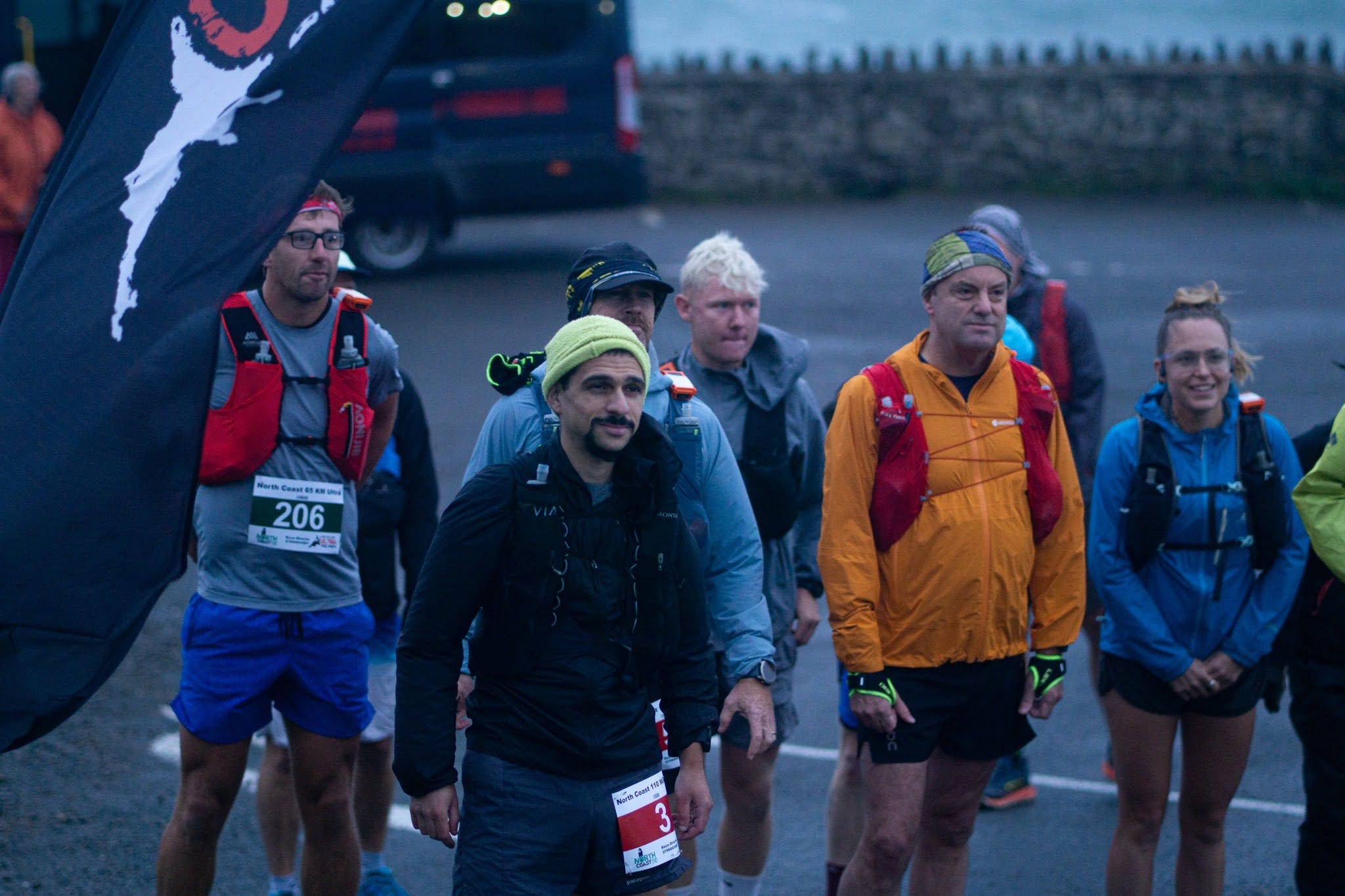
Over its gnarly, exposed 110 miles of coastal trail, Storm Amy’s 65mph winds came within a hair’s breadth of blowing me into the ocean, before shooting tree branches directly at my head.
My dodgy hip flexor - in such a poor state from those long hours sitting at a desk - deteriorated until I was barely able to move. It forced me into an agonisingly slow and painful limp some 40 miles to the finish for second-to-last place, just before the cut-off. After that excruciating experience, I couldn’t even contemplate running for months.
It took until December for me to restart regular training. Legends Trail was in February, just a couple of months away. If Jandalf was right, and this was anywhere near as difficult as Spine, then just 8 weeks of training - starting from literally zero - was not going to cut the mustard.
So I gambled, jumping straight into high volume training without any of the usual ramp-up period. A high risk strategy, but I figured it was my only chance.
The high volume training worked for a while. But 6 weeks later in January, when even longer hours at work starved me of the sleep and nutrition necessary to support my training load, I came unstuck.
My Achilles tendon had been tightening for a few days. During a hill training session with my club, it began to fail - painfully. And after I’d limped back home, it deteriorated rapidly. I couldn’t run. I couldn’t walk. It turned out, I could barely manoeuvre around the house.
With only a month to go until Legends, it was clear. My Achilles was buggered, and I had full-blown plantar fasciitis. I would have to set my Legends ambitions aside, and DNS.
But we were supposed to run as a trio: Jandalf, Atomic Barista and I. Three quarters of our Savage quartet tackling the inaugural Legends 350 together. And I’d given Jandalf my word that I would answer his question: Spine or Legends, which is tougher?
With no resolution to my predicament, I did what I’ve always done in these situations. I regressed even further into my work, pushing Legends Trail far back into the deepest recesses of my mind.
It was Sunday afternoon, two days before my Eurostar to Legends Trail in Belgium. Not only was my Achilles still completely buggered, but I was seriously unfit, I hadn’t researched the race, the weather, or made any preparations: kit, nutrition, drop bag. Nothing.
I hadn't even responded to repeated, urgent requests from the race director to complete his mandatory registration form. What was this race, anyway? I skimmed its website and a couple of race reports.
I learned that last year’s edition of Legends Trail involved 250km of muddy, snowy, waterlogged, off-trail craziness. It sounded like a navigational nightmare, wading through rivers, clambering over barbed wire fences and getting lost in dense forests. And for 2026, the organisers were switching up the route, adding 100km to its distance. So - a 350km off-piste bushwhack through the Belgian Ardennes, with more total vert than UTMB. It sounded fairly serious.
Then I read the mandatory kit list. There was very little to it, which was surprising to say the least. If Legends really was as tough as everyone claimed, how could the organisers demand so little safety gear?
Concerns aside, with only a couple of hours to prepare my kit, I counted myself lucky. There wasn’t time to order any new gear, or even head to the shops. What I didn’t have immediately to hand, I couldn’t take to Legends. It was as simple as that.
To make some sensible decisions, I needed to know something about the conditions I’d face. I picked an Ardennes town at random and checked its weather forecast for the week ahead. The conditions didn’t look too bad at all - quite pleasant, in fact.
So I didn’t add much to my drop bag beyond the barebones mandatory kit. Just some extra waterproof socks, a spare jacket, baselayer and a couple of midlayers. And with that, I wrapped up my preparations for the night.
Late Monday evening after work, I carved out 15 minutes to prepare a nutrition strategy. I usually had plenty of sports nutrition lying around, but to my surprise and mild horror, my stock cupboard was almost empty. At a bit of a loss for how to meet my carbohydrate requirements, I settled on the only sugary thing I had to hand: some half-kilo blocks of marzipan.
I paused, stroking my beard. Fuelling a 350km race entirely on almond paste. This wasn’t something I’d attempted before. Was this sensible... or even feasible?
Was any of this sensible or feasible? My Achilles and my heel had not improved one iota. I could hardly walk. Just attempting this race might make things much, much worse. And I really didn’t want to kick off the 2026 race season with a six-month recovery period. It wasn’t worth it, not for a race I couldn’t possibly be competitive in.
So, between my couple of spare pairs of waterproof socks and my blocks of marzipan, I decided then and there that I would DNF. When exactly, I would leave to circumstances; but the one point I was crystal clear with myself was that I would DNF at or before CP3.
To protect what remained of my knackered Achilles, I would not, under any circumstances, go beyond CP3.
Of course, I’d issued similar ultimatums before, such as when I was ill for UTS. Despite not being able to differentiate between the symptoms of illness, dehydration and malnutrition, I forced my beleaguered body around the entire course anyway, triggering a protracted illness that lasted for months.
Then there was the illness leading up to Cockbain’s Track 100. I was only going to run for a few hours, I said - and to ensure that happened, I only brought a few hours’ worth of food to the track. But even that didn’t stop me. I dragged my starving body around the whole damn thing anyway.
This time, I was clear. I was going to run some of the race, just enough so I could answer Jandalf’s question. And then I was going to DNF by CP3.
CP3 was my red line.
Frankly, considering the state of my foot, I doubted whether I’d even make it as far as CP1.
In Liège, Belgium, I stayed in a hostel with race veterans Jandalf and Atomic Barista - and Frank, a fellow first-time Legends runner. Although, as I quickly discovered, he’d spent a year researching everything there was to know about this race, and was just as prepared as the other two.
As we whiled away the evening playing board games, I began to pick up hints about the course that lay ahead of us.
Ground conditions would be waterlogged, muddy, and swampy. Heavy rain was expected. There was a notoriously exposed section over the High Fens that would be technical, slow and freezing cold.
Then they discussed their kit preparations. Everything they mentioned triggered a realisation that I wasn’t prepared for what was to come.
Gaiters - I’d forgotten to bring mine. A water filter - a rather important piece of kit for a race like this, but it hadn’t even crossed my mind. Spare waterproof socks for each of the five CPs - I’d brought a couple, but not five. Caffeine - I had plenty back in ‘Blighty, but that wasn’t very much use to me here.
Had I read the map? No. Formed a sleeping plan? Hardly - I hadn’t even managed much decent sleep in the weeks before the race. Reproofed my waterproofs? Not since last year’s Spine. Had I prepared home-cooked race nutrition? I thought back to my blocks of marzipan…
Had I at least brought a functional race pack? Only an hour ago, I’d spotted I’d accidentally brought my pack from last year’s Spine. The one whose zippers and straps were all broken.
Winning our second board game did little to lighten my mood. The level of planning and preparation these three had devoted to the race over the past year was eye-opening. And while Legends didn’t sound like Spine-level difficulty to me, it also didn’t sound like the sort of thing one should limp up to with a buggered Achilles, some damaged fair-weather clothing, and one’s body weight of marzipan.
We weighed our drop bags to confirm they were under the 20kg limit. Mine clocked in a smidge over 10kg. Not only the lightest of the lot, but just plain objectively light. Red flag light?
For the Winter Spine I’d spent months buying, testing and refining my kit, and days tweaking spreadsheets to tip my drop bag just under the 20kg weight limit. If Legends was in any sense comparable to the Spine, was rocking up with a half-weight drop bag nonchalant - or negligent?
There was a short traipse back to the hostel from our pre-race evening meal. I hobbled painfully over Liège’s pavements, unable to keep up with the others, eventually stopping to give my Achilles a rest.
Never mind DNF’ing at CP3 or CP1. I was struggling to make it 500 metres across Liège.
Since Legends didn’t start until 6pm, there was ample time to lie-in and ponder what on earth I was doing here. At a loss for answers, I hobbled out for a casual brunch at café Konno. “Better food, better mood” was their claim. Their curried parsnip dish, combined with a delicious decaf, certainly had me feeling more upbeat by the time I left.
Come 2pm, another Legends runner, Patrick, kindly gave us three Savages a lift down to the start in Bernardfagne. Volunteers funnelled us through a series of rooms for mandatory kit checks, tracker fitting, and the worrisome medical Q&A. I didn’t want them to spot my hobble and blackball me. So as I entered the room I greeted them loudly, telling some bad jokes and gesticulating my arms wildly to divert eyes away from my feet. Whether they spotted my hobbling or not, they gave me the A-OK to proceed.
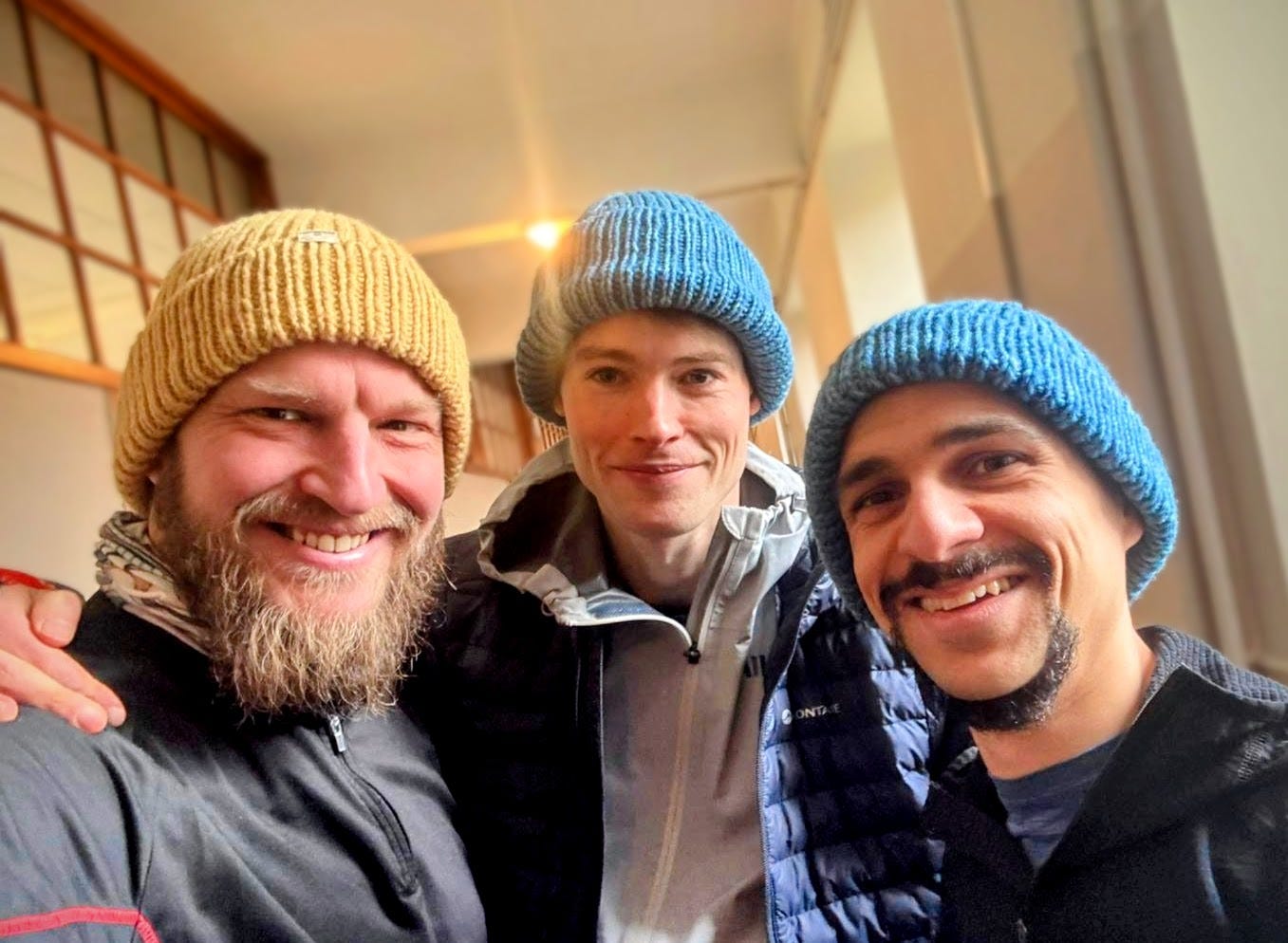
With all the formalities out of the way, it was time for us three Savages to don our Longbridge BYU winner’s beanies and snap a photo for the album.
Two hours remained to immerse ourselves in the raucous atmosphere in the race HQ common room.
Filled with Legends veterans and world-class backyard ultra champions, I could feel the tense energy and expectant excitement in the room. This made it all the more difficult to accept my predicament: not only would I fail to finish, but this would be my first ever DNF. I weighed my personal woe against the enthusiasm of my friends, and tried hard to stay on their wavelength.
So I whipped out my GoPro and bellowed toward Atomic Barista: “Give us some advice!” He laughed, knowingly. “Just be ready for four nights outside.”
Four nights… that took me aback. I hadn’t prepared for that. Come to think of it, I hadn’t even looked at the cut-offs. When did the race actually end? I dismissed the question - it wasn’t like it mattered. My busted foot wasn’t likely to get me through the first night, let alone the fourth.
We shuffled outside to the start line within Middle School St-Roch’s pristine central courtyard, among its manicured lawns and 12th century Hogwarts-style buildings.
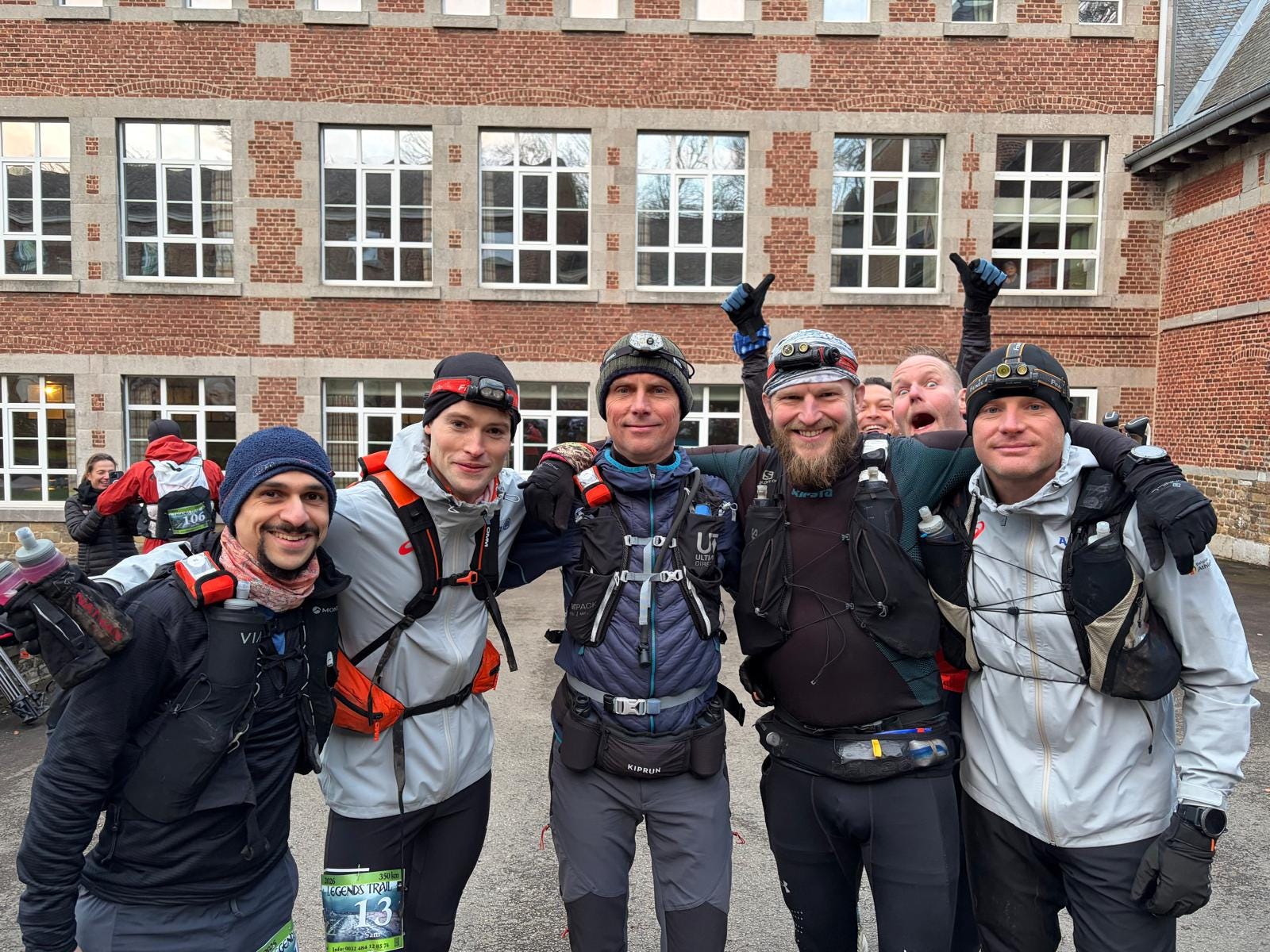
I missed most of the multilingual race briefing. I was busy wrestling with my Garmin, trying unsuccessfully to get a GPS fix. But this made me no never mind. I was in pain just standing here. I’d hobble off the start line, drop off the back of the pack, and drop out long before the first checkpoint. This wasn’t going to be a performance worthy of a Strava upload.
Everyone began chanting what I presumed was a Dutch countdown. Their words blended into the ghastly wail of an air raid siren, and those around me started moving.
I’m hobbling. Legends is underway. A fact that’s completely lost on my Garmin - not for the first time, the bloody thing’s clueless. It’s fixed just enough satellites to know it’s somewhere in Belgium, but beyond that...
I feel clueless too. I don’t know much of anything about the course. I don’t know about the aid stations. I don’t know about the cut-offs. I don’t know whether marzipan is a viable nutrition strategy. And I don’t know… am I really going to DNF?
Because I don’t DNF. I’m the Trail Explorer. I explore trails - to the bitter end, come heather or high water. That’s my identity. Why would I put that at risk?
Yeah, yeah, I know - I’m answering that question: “Spine or Legends - which is tougher?” But I can answer that now: Spine is tougher, obviously. I don’t need to destroy my identity to answer that.
Destroy my identity…
I don’t want to do that!
What on earth have I done?
I’ve made a mistake.
I need to stop.
But if I stop, that’ll DNF me.
Fuck! How did I get myself into this?
How do I get out of it?
Garmin’s still searching for satellites - it doesn’t know I’ve started.
But the Legends tracking system does.
There’s always a way out.
I just need not to have started.
I need to rewind time.
Where’s the “rewind time” button?
It’s not there.
I’m going to lose my identity.
Help me…
Continue reading The Battle of Achilles (Part 2).
You are insane