


Monitoring one’s climate impact is not a passive endeavour. As in quantum mechanics, observation affects behaviour.
It’s closely related to gamification. As soon as we define and track concrete metrics, we introduce competition, targets, and achievement. Highly motivating factors in their own right.
A strong motivator to reduce one’s climate impact is, to be sure, a good thing. But there is a risk of taking it too far. Of obsessively optimising around only these specific metrics, at the expense of others.
Now; if wider society were also grappling with the same sustainability conundrum, then the discussion of strategies to balance sustainability and quality of life might be an integral part of our national discourse, and answers might be easier to come by.
But when most are principally concerned with personal wealth (completely understandably, given the crisis of wealth inequality and falling living standards); when politicians and academics are still obsessing over GDP, and when laws, regulations, incentives and media publications are principally aligned to profit or populism; then it can feel quite lonely, out on the far reaches of society, wrestling with the practices and consequences of moderating one’s climate impact.
Is this battle sustainable in the long-term - can one really maintain a behavioural divergence with wider society, while meeting one’s own psychological needs?
Lately, I’ve been pondering whether this is a question I will ever need to answer. Because while fascist leaders deploy Orwellian tactics to deny the reality of ecological breakdown, ordinary people are working harder than ever to build-in sustainability from the ground up.
Locally, repair cafes are springing up. Libraries of things are emerging. Freecycling groups, charity and second-hand clothes shops are thriving.
The National Running Show sports a dedicated presentation zone managed by The Green Runners. Even UTMB is improving - this year, one can get a 30% UTMB ballot “boost” by committing to (and demonstrating proof of) greener, plane-free travel to Chamonix valley. They even provide a bespoke travel planning app to help.
In a few years’ time, might sustainability-based entry & financial incentives be the norm for races and events alike?
Will we, in the relatively near future, reach a point when sustainability is a core component of our cultural conversation? When factoring sustainability into day-to-day decision-making requires no societal explanation or justification? When, in fact, it is unsustainability that is met with an inquisitive eyebrow-raise?
If ever I’ve felt confident that such a societal shift is not just possible but inevitable, that time is now.
Travel
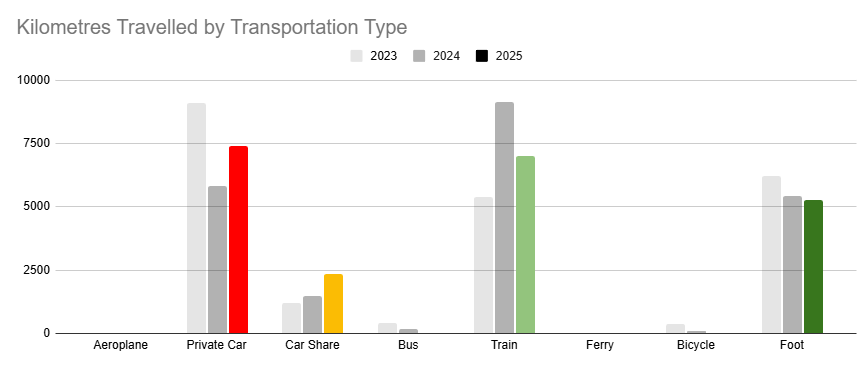
Just as I did in 2024, throughout the year I worked hard to keep my car use low; preferring trains, car sharing or journey avoidance wherever possible.
However, my pedestrianism showed a slight year-on-year decline, and I only got on my bike on a handful of occasions. This is largely attributable to more race injuries and long recoveries, not least those from my second running of Winter Spine, and the debacle surrounding North Coast 110. This was all layered atop another very busy year at work that left little time for slow activities.
It’s my goal in 2026 to build a more sustainable work/training regime that will, I hope, demonstrate an improvement across these metrics.
International Travel
For the first time in many years, I didn’t travel internationally. All my races and breaks were local to England and Wales. This was a conscious decision I made to keep my carbon footprint low.
Note this isn’t something I intend to maintain year-on-year, but simply a recognition that carbon is still correlated with mileage (whether that’s travelled by plane, vehicle or train), and that I oughtn’t need to travel internationally every year. As cold, windy, wet and flat as Britain can be, there are still plenty of opportunities for adventure and exploration within the confines of ol’ Blighty’s coastal waters.
Food
For the sixth year running, I consumed a 100% plant-based diet.
And for the fourth year running, while I did still grow food in my front garden, my heart wasn’t in it, and I didn’t make as much of an effort as in previous years.
I still had a good crop of strawberries and runner beans. There was the odd cabbage and head of broccoli, some chard and chillies. And, in a first for me, I did attempt to grow some sweetcorn. But all-in-all, I didn’t make time to give the garden the TLC it needed to produce good crops this year.
Whether I’m able and prepared to commit extra time to my horticultural endeavours this year is a decision I’m deferring until the spring.
Energy
I continue to use a 100% renewable electricity energy supplier.
However, again, this year’s outcomes followed on from my work-life balance. Slightly more time working, slightly less time spent active, and injuries and recoveries alongside required an uptick in heating and energy consumption:
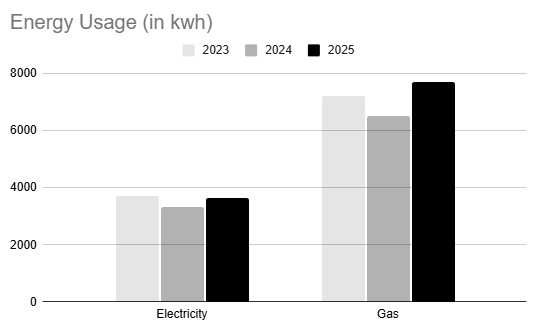
I hope that improving my work-life sustainability balance will produce better outcomes in 2026.
Running
As part of The Green Runners, I am renewing my pledges:
Prefer local races & training
Make my journeys by foot, bike, train, bus or carpool where possible
Track and report my carbon footprint annually
Be proud of & publicise kit longevity/repair
To address that last point, I’ll sign off on my annual report by updating you on my trusty old Kinvara 12 running shoes.
Still clinging on to life after last year’s patch-up repair job at 3,300km, they have subsequently conveyed me an additional 900km, taking their total to over 4,200km.
To be sure, their soles are increasingly treacherous on slippery ground, their midsole foam has long deteriorated past the point of providing any discernible cushioning, and my repairs to their outers have fallen apart, leaving them as open as a colander.
Despite all this, they still work perfectly as minimalist training shoes!
Will they reach 5,000km by the end of the year? Let’s see, shall we…