


Continuing from Operation Oolong (Part 4).
The night was as black as the Mariana. No photon dared approach these Ardennes trenches, their Shining too dark to submit to illumination. An ocean of ink rendered my eyes redundant. Presumably, space was abundant here in Brandolini’s flooded abyss - but how could I know for sure? While my legs still turned, I was deprived of all worldly context, so only my thoughts remained. Mais, bien sûr; je pense, donc je suis - non? Peut-être… but if a soul moves the ink, and no other soul is there to feel the waves, did they run anything worth reading… worth continuing?
It started as a solitary ray of light. Faint at first, opening up into a rectangular portal that shimmered mysteriously over obsidian glass. A male silhouette swum across the page, gesturing toward the light.
Was this page one of Douglas Adams’? Perhaps the light I could see was Milliways, the restaurant at the end of the universe. That might make me Zarquon. Running late as usual, with just enough time to announce my intentions.
I locked onto the apparition, kicking ever faster through the ink, transfixed as the light intensified, expanded, and finally - exploded.
Burnenville Hall, CP3 looked nothing like Milliways, but I felt at ease beneath its vaulted timber ceiling. I could see a stage at one end and a bar at the other. It was a community hall, perhaps? No fewer than six volunteers stood to the side, applauding as I entered.
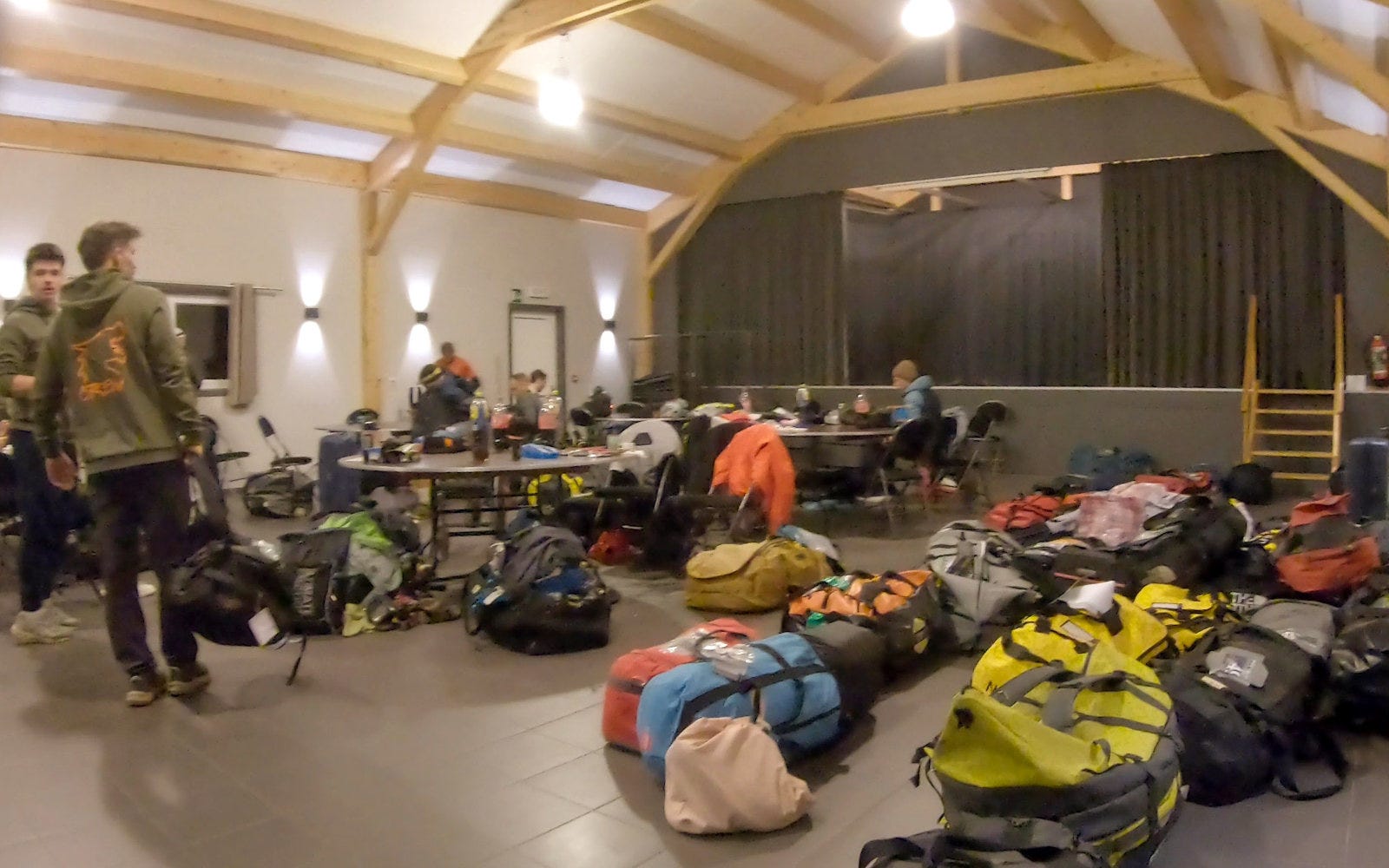
Whichever end of the universe I had reached, it was a welcoming place: warm, calm, and homely. With only a few runners milling around the checkpoint, there was ample space to stretch out and relax in the quietude. Yes, I decided - this was the perfect place to fulfil my prophecy, announce my DNF and watch my race implode. And I could do it all while enjoying a plate of dahl and a cup of oolong.
I would feast and sleep. Then I’d congratulate the other runners traipsing in. Perhaps I’d watch them preparing for their next leg. In the fullness of time I’d be transferred back to Race HQ at Bernardfagne. There I’d track Jandalf, Atomic Barista and Frank’s progress, and I’d wait by the finish to celebrate their success.
Everything was laid out for me here at CP3. It felt right.
A volunteer beckoned me toward one of the large round tables. I took aim at a comfy looking chair. That was where I would announce my DNF, I decided, right next to my drop bag.
Right next to my drop bag…
Those three words detonated in my brain, stalling my legs. My drop bag wasn’t here to help me DNF - quite the opposite. It was here to help me prepare for the next leg. Because that’s what one does in a checkpoint. One prepares for the next leg.
Back adrift in the Pacific, my splashes cast inky waves out into the darkness. Now those waves were circling back around to envelop me. They whirled ever faster, spinning and sucking me down, down, down into the depths of the abyss.
While I kicked and protested against the ink, I was not alone in my dialectic struggle. At my side was Achilles. He leant toward my ear, and as calmly as Sun Tzu himself, he whispered “you’ve got to fight”.
Fight who? I paused, momentarily; long enough for the ink to overwhelm me, overtopping my head, silencing my protestations.
If I knew only one thing, it was that I must fight.
What of Operation Oolong? What of logic, of temperance, of wisdom? What of my tendon, my heel, my Summer Spine? What of Eric, or Sergeant Wilson for that matter - “Do you really think that’s wise, sir?”
Fuck!
The whole point of this race had been to DNF - to experience some of Legends Trail, avoid any long term damage to my Achilles, answer Jandalf’s question, and above all to quit by CP3. And as if by magic, here I was at CP3. I’d done everything I was supposed to. All that remained was to utter those two simple words: “I DNF”. I only had to say the words. Say the words.
Just say the fucking words!
The volunteer was still trying to beckon me over, now looking a little concerned. I feigned a smile and shuffled over, slumping into my DNDNF chair and stripping my socks, shedding two small molehills of mud onto the checkpoint floor. Gazing forlornly at my drop bag, I knew I couldn’t do it. I couldn’t DNF. And that made me feel like utter shit.
A minute passed with no great insight or revelation. It was decided, it seemed - I was to fight something I couldn’t name for a cause I couldn’t put my finger on. Spiffing. That being the case, I’d better devise a strategy for this checkpoint. Even that would be challenging, seen as I hadn’t brought any kit for CP3 or beyond. Exasperated with myself, I rapped my fingers on the table and sighed forlornly. What a mess this was.
If I was actually setting back out on the fourth leg, then I needed to take it a whole lot more seriously than the first few legs. This was the longest yet; and arduous, featuring the High Fens that everyone had taken great pains to warn me of. I’d face them with a completely buggered Achilles, in bad and worsening weather, without much kit, and with no proper sleeping gear to fall back on.
I ran a quick mental calculation. By my sleep-addled estimations, I’d been running for well over thirty hours, and awake for forty. This was the prime time window for sleep deprivation to kick in. I’d better catch some shut-eye before I got back underway. So I inflated my sleeping mat and grabbed my sleeping bag. For some reason, Legends race rules disallowed any sleeping inside checkpoints, so I asked a volunteer where they suggested I bed down.
I followed them back outside into the darkness and spitting rain, where I splashed along in my slippers until we reached a simple pole barn. It had a concrete floor, a brick wall to one side, and - to my surprise - a roof over the top. While the structure left three of its four sides open to the weather, this wasn’t the fully exposed, fend-for-yourself sleeping situation I’d expected.
That said, neither was it without its challenges. For one, the barn opened directly onto a car park that was overflowing like a shopping mall during the Boxing Day sales. Cars were queueing for spaces, flashing their high beams, honking horns and billowing fumes. The cause was clear, and that doubled as the second problem - behind the car park was a rural destination nightclub. Its multicoloured disco lights were projected over the concrete floor, and its booming bass was reverberating through my eardrums.
My options, though, were few. I could either bed down in this ‘Bag & Boom’ B&B, and dream of shopping malls packed to the rafters with industrial-grade ear defenders. Or I could squelch off in my slippers through the pitch-black woods, to find a nice quiet spot in the mud. Weighing my two options, I settled, sensibly I thought, on the Bag & Boom - but frankly there wasn’t much in it.
I set an alarm for an hour, spread out my sleeping bag, and lay down, not entirely convinced this was going to work.
90 minutes and some snoozing of the alarm later, I called it quits. I thought I had managed some sleep, though I wasn’t exactly sure. I scooped up my sleeping gear and splashed back through the darkness to the checkpoint.
It was a relief to be back inside the relative quiet of Burnenville Hall. Next on my mental list after sleeping was ‘breakfast’. Without any oatmeal to hand, I could choose between marzipan or one of my dehydrated dahls. At least this decision was a no-brainer - the dahl it was.
I was halfway through my inadequately spiced breakfast when the volunteers began applauding just like they had when I’d arrived. I glanced up in time to see my friend Frank slopping into the checkpoint. He planted himself broadly, beaming a victorious smile as water poured off his jacket and pooled around his shoes. “Hurrah!” I shouted, beckoning him over to the chair beside me.
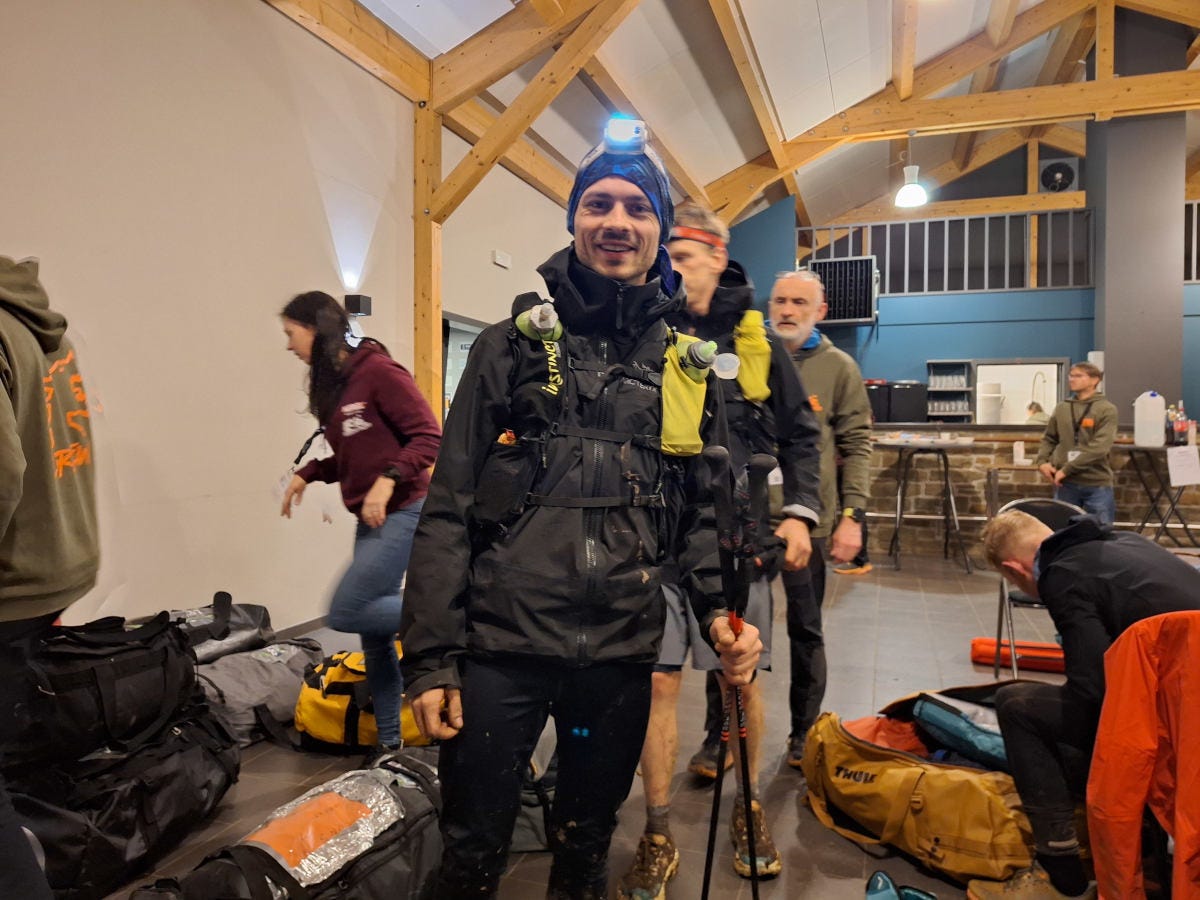
You may recall from earlier in the story that this was Frank’s first Legends Trail too. He’d researched and prepared for this race meticulously over the past year, so I was eager to see how he was faring.
I looked him up and down and had to admit, he seemed in remarkably good shape for someone who’d just swum 100 miles. I observed him setting about his checkpoint preparations calmly, projecting an assurance that’s quite rare to see outside of the top 20% of the field at this stage of an ultra. Which reminded me of something Atomic Barista had said before the race began, something to the effect that Frank shouldn’t be underestimated. Piecing it all together, I was developing the opinion that, despite his relatively tight timing here at CP3, Frank would achieve his year-long goal of becoming a Legends Trail finisher.
Unfortunately, Frank went on to ask me about the sleeping arrangements. That meant I had to break the bad news about the Bag & Boom, and I braced for his face to fall - but he just laughed it off. He seemed keen to experience the unusual arrangements for himself, and hurried off with his sleeping gear under one arm, sporting a wide, spirited, slightly masochistic grin.
Spotting that I had some mobile signal here in the checkpoint, I figured I ought to check the weather forecast for the route ahead. Predictably, the 25+km High Fens plateau had no weather stations, but there was a German town some way to the east which did. On seeing its name - Monschau - my eyebrows rose, for I’d visited many years ago. It was one of the most beautiful towns I’d ever seen.
Today, Monschau’s weather wasn’t worthy of a visit. Heavy rain, 30mph winds, and it was worsening. Given the boggy High Fens plateau stood 650 metres higher than Monschau, conditions up there were bound to be worse. By how much, I could only guess.
Legends’ race organisers mandated surprisingly little kit, and so far I’d run with my 20L Montane Gecko pack mostly empty. I had plenty of space to add extra gear to handle the conditions. The only problem was that my drop bag was also mostly empty. What did I have, really, aside from wet socks and marzipan? I emptied my drop bag, spreading everything out for a comprehensive audit.
I found a warm midlayer and an emergency bivvy, both of which I added to my pack. And then there were my long trousers, which I put on beneath my shorts. Finally, there were the wet socks and marzipan. While I sagely left the wet socks behind, I did take some of the marzipan, before setting back off into the rain & darkness.
The leg to CP4 began with a decent climb up through the woods to the west of Malmedy. Straight away I worked up a sweat and reproached myself for starting in long trousers. I stopped in the rain to strip back to my shorts and base layer, feeling much more comfortable for it.
I was moving fairly well under the circumstances, transferring load to my upper body by driving through my poles - but I was only doing this because of the pain in my Achilles. At this moment, it felt extremely weak, as if any minute it might ‘go’.
That wasn’t any great concern down here, while we periodically popped out of the woods to cross an occasional road. But if my Achilles ‘went’ up on the remote bogs of the High Fens, then I might face a rather more serious situation.
If my right leg became immobilised and I needed to be rescued off of the plateau, that might take hours. The whole operation would tie up safety teams that might be needed by other runners in distress. I couldn’t justify denying other runners the help they so desperately needed, just because I’d irresponsibly chosen to fight through a pre-existing injury, for something I couldn’t put my finger on. The only conscientious course of action, I decided, was to return to CP3 and DNF.
But I’d already ruled that out. The only option remaining that I could see was to take full responsibility for myself from here on in. So if the worst happened and I couldn’t move, I would have to self-rescue off the plateau. Even if that meant dropping to my hands and knees and dragging my fucked leg 10 kilometres through the bog, over snow and ice, under torrential rain and wind, with fuck-all kit - then so be it.
With that, I decided it would be for the best if I no longer considered myself part of the Legends Trail race. I metaphorically ripped off my Legends Trail running bib and quietly committed to continuing as a solo runner. From here on in, I decided, I was on my own.
Far from adding to my list of concerns, this felt like an act of liberation. It alleviated my nagging sense of guilt, which allowed me to relax into the run. And now I actually felt relieved that I’d not DNF’d back at CP3. These Ardennes trails were so beautiful, the opportunity to explore them so unusual, and my ability, under the circumstances, to continue so incredibly unlikely, that I felt immensely privileged just to be here.
Just like that, Brandolini’s inky ocean drained away, and I could grasp the fleeting truth right in front of my eyes: we were not so very different, the Ardennes and I.
The breaking of the day revealed the true nature of these remote trails. Hilly, muddy, and frequently awkward to navigate. Most of the time I was off of any beaten track, trying to orient myself toward wherever I perceived the route to be. Whether this was because of the race organisers’ fiendish route setting, or simply poor navigation on my part, I could hardly tell.
Pace-wise, with my Achilles as it was the best I could manage was hobble-running interspersed with fast hikes. But my perseverance paid off when I joined a beautiful trail high up in the Warche river valley that tracked the course of its waterway down below. Winding trails nested within ancient woods, serenaded by rushing water and birdsong: no matter my physical state, it was quite impossible for frustration to take hold in this Eden.
A couple of hours along the dreamy trail, I was on the verge of dozing off on my feet. Clearly, my shut-eye back at the Bag & Boom hadn’t been anywhere near as recuperative as I’d hoped. Like a bird, I closed one eye while keeping the other open, searching for a spot away from the narrow singletrack where I could stop to rest.
A switchback dropped me into the bosom of the valley beside the river’s edge. Down in this secluded haven I felt in urgent need of sleep. No sooner had I crossed the river’s bridge, I came upon the perfect little sleeping spot: a wooden picnic bench with a roof. I stretched out along its slats and set my alarm for 15 minutes.


Whether I managed any sleep here I don’t really know, but when my alarm sounded the worst of the drowsiness had dissipated. I resumed my run bleary-eyed, only to be faced with a rather steep 4-point scramble out of the valley. It led to the water’s edge of the Bayehon river where a singletrack snaked upstream, then forked right onto its major tributary, the Ghasterbach.
The going grew tricker as the trail criss-crossed back-and-forth across the river. Sometimes the crossings were easily identifiable, but increasingly they were not. I had to assess each scene carefully, picking out rocks, fallen treetrunks, snowy tufted islands... it was certainly better to avoid wading through its fast-moving currents.
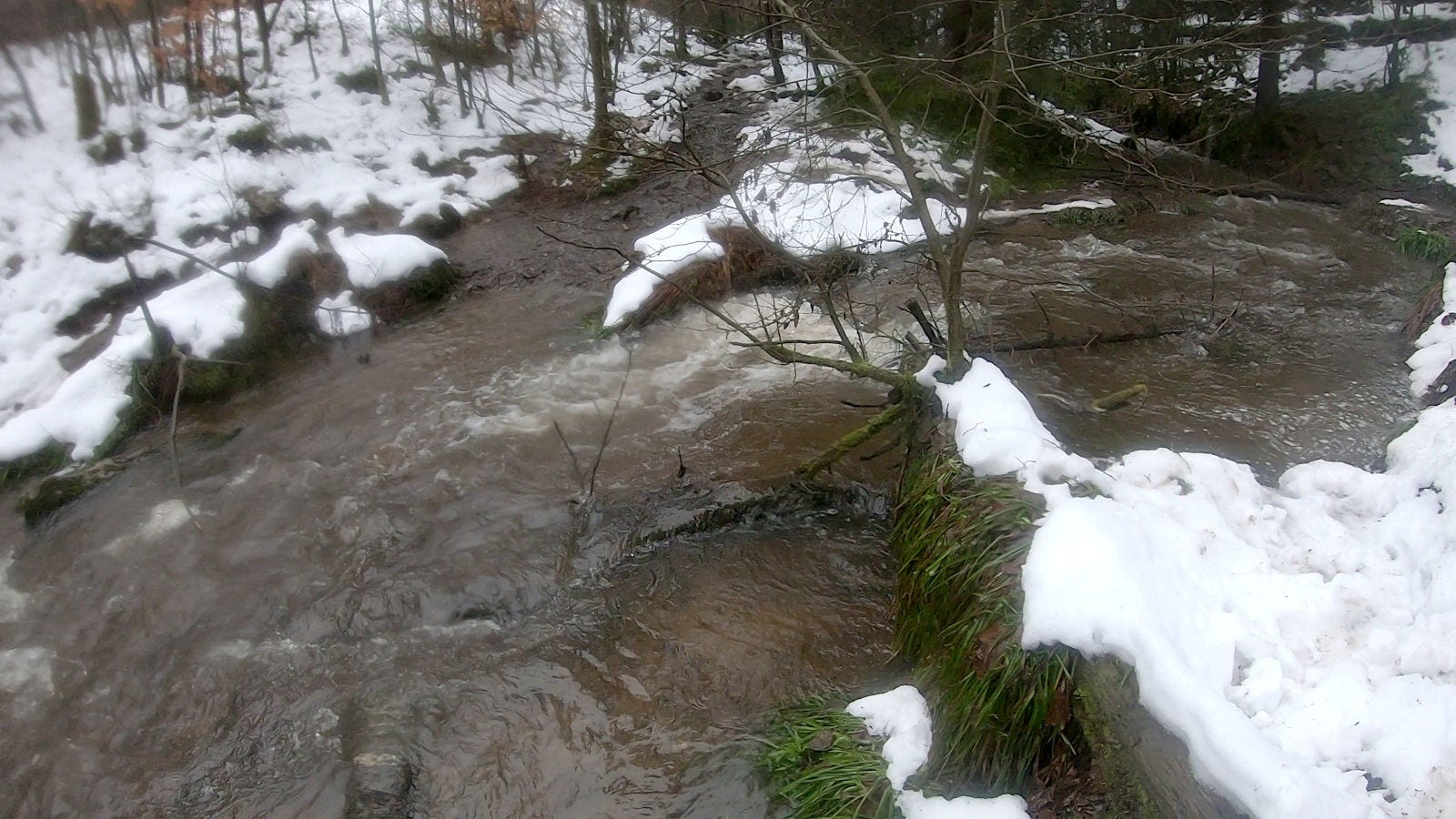
As I climbed ever higher, even the ground trail grew trickier. It transformed into a mix of thick mud, waterlogged peat and snow. But now I stalled at a crossing that really did have me stumped. I couldn’t see any alternative to wading through the torrent of churning, angry energy.
For a runner as short as I, it looked sketchy. Without my poles, I’m not sure how confident I’d have felt attempting it. I spent a good minute wedging my first pole as securely as I could between a few rocks, locking it in place at an angle so it wouldn’t snap in two when the raging waters loaded it horizontally.
My first step into the water demonstrated its force in a flash - despite all my careful preparations, it nearly had me away. While I worked fastidiously to anchor my second pole as securely as my first, the riverbed was loose, and I struggled. Toiling against the relentless force of the waist-deep waters, I grew tired just holding my ground. I needed to keep moving. I placed my trust in my second pole and committed to another bold step, nearly losing it again while I transferred my weight. This dodgy ford continued in earnest, until I was close enough to risk leaping onto the snowy bank opposite.
My beaming smile from having crossed without incident gave way to a smirk when I saw what lay ahead. The ground was much worse on this side. These mild winter temperatures were probably doing me a disservice, I mused - all the melting snow had formed a water wonderland here. Sticky mud, quick peat, deep puddles and ponds, some of which would all too readily devour a misplaced foot. While tufts of snowy grasses offered islands of security, progress was very slow, and with every step came a new puzzle to solve.
While I was preparing myself mentally to endure endless hours navigating the Ghasterbach’s muddy swamp-pond banks, when I stuck my head around a cluster of snowy pine trees I did a double-take. Right in front of me was a structure that looked strangely like a whacking great warehouse.
I trotted around the side of the enormous building, turning my gaze to a fancy-shmancy sign that read ‘Peak Beer’. And around the front, I could see this was, indeed, a brewery, taproom and fine dining restaurant. Had I finally found Milliways? Perhaps its chefs might be able to work some magic with my marzipan.
The roads around the brewery offered temporary relief from the ghastly Ghasterbach’s banks. Flat tarmac covered with light snow, slush & puddles was quite a treat, though the roads soon petered out, revealing a very different landscape ahead.
The Hautes Fagnes
As soon as I saw it, I realised this was what I’d been fighting for. The High Fens was what defined this race. I couldn’t have left without seeing them.
I paused, taking it all in. What stretched out in front of me looked like the high moors of the Black Peaks.
In winter, their peaty ground acts like a sponge, holding onto water where it can, and filling ponds where it can’t, creating a classic bogland. Each footstep becomes a little game of Russian roulette. It could hold firm, sink into waterlogged peat, disappear as far as one’s knee, waist, or beyond.
Unless one aims for the tussocks: those innumerable islands of tall, yellowed grasses that offer a sure foothold. You can leap and bound across them to stay above the bog. Though you can’t always move forwards. You may need to move diagonally, to the side, or backtrack where necessary. Journeying five or ten metres to move forward just one.
Choose your path: as the crow flies, where you’ll overwork your calves at best and disappear into the peaty underworld at worst; or track the tussocks, where you’ll spend thrice as long and expend four times the energy, but enjoy a more stable passage.
I gazed ahead at the Fens, weighing my options. Ordinarily I’d take the direct route to save time, but given the state of my Achilles I worried that repeatedly wrenching my foot out of the peat might just tip it over the edge. I really had no choice but to take the long route, and track the tussocks.
I bounded from tussock to tussock under an ominous, murky sky. The rain I’d been ignoring for some time was only just starting to build in intensity. My waterproof jacket was already well saturated, bleeding water through to my torso, while my paper thin racing shorts left my legs entirely exposed.
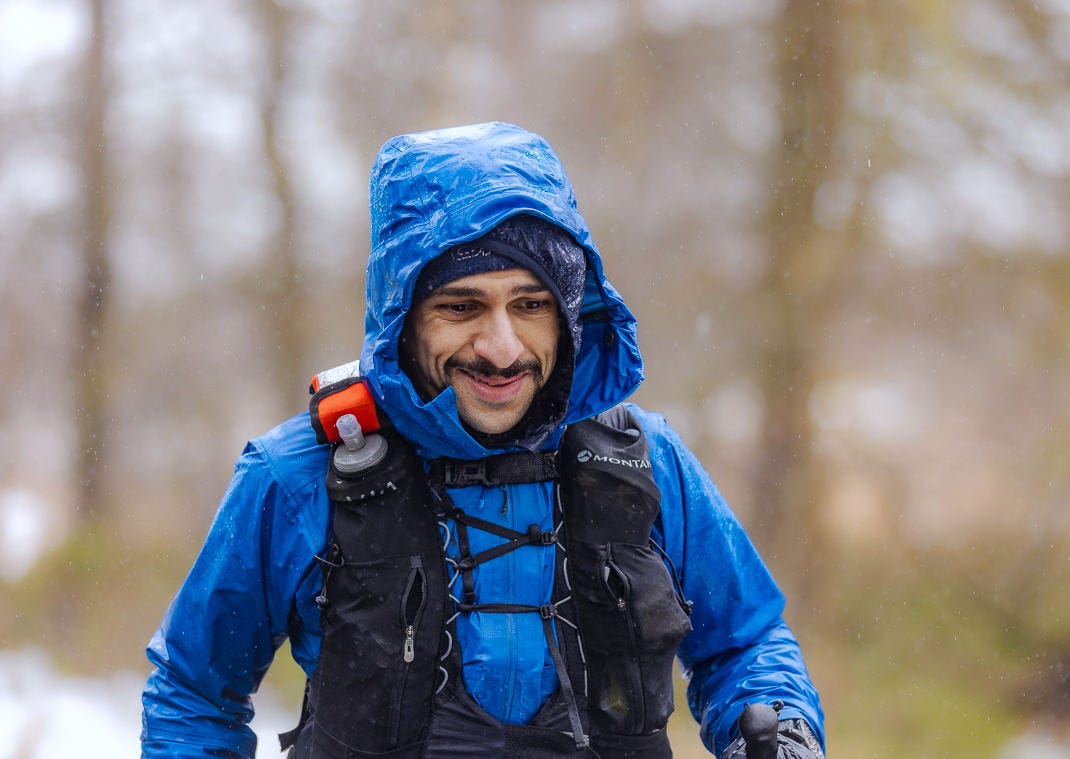
Despite the deteriorating conditions and my questionable state of preparation, I felt a cosiness in this bumpy section of the Fens. It was as if I were permanently nestled within my own little private nook of the Earth’s surface, like one might imagine exploring an enigmatic woodland fairy tale.
Ever curious about what lay over this mound, or behind that cluster of pines - a magical adventure could almost certainly be found within a few strides in any direction. And with no other place to be; no barbed wire fences constraining me, no ‘Keep Out’ signs threatening me, and no concern over being branded a ‘trespasser’, I truly felt at liberty.
But time seemed not to be on my side. For the further I travelled, the more the wind picked up, the heavier the rain fell, and the worse this bog became.
The tussocks grew fewer and further apart, until they were far too far to bound. The peat deepened and grew stickier. My Achilles had to work overtime to extricate my foot from each step.
Just as the bog started to feel insufferable, some help emerged. Short stretches of wooden boardwalk provided an easier passage over some of the worst sections. Though, also over some perfectly runnable sections, and it was missing from some true quagmires. While I couldn’t quite understand the logic of their placement, I appreciated their presence, for they made the going much easier.
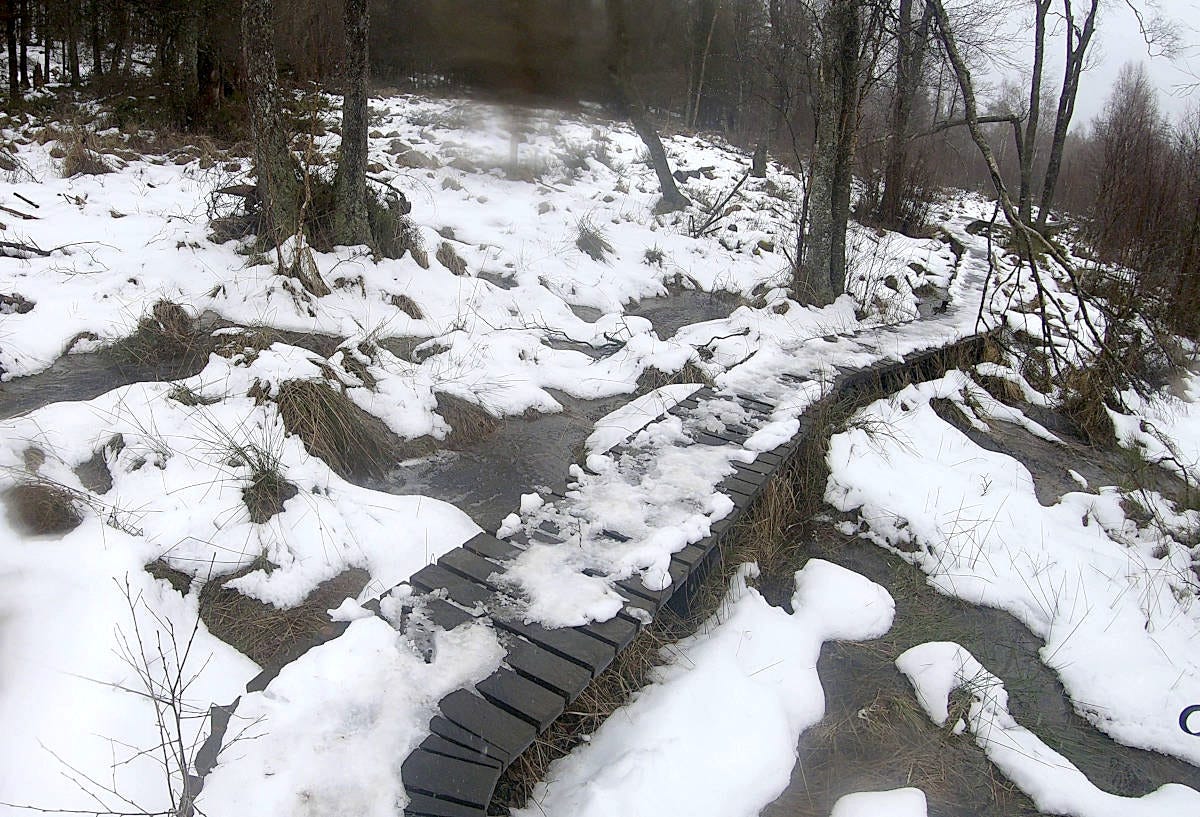
The deeper I ventured into the Fens, the longer these stretches of boardwalk became. And where they’d started just centimetres off the ground, they now rose much higher. Some stood a full metre in the air. When coupled with their coating of snow, slush and ice, slipping off them became a real possibility. Something that could end in an unpleasant accident.
Amidst the boggier bogs and dangerous decking, the weather was also ramping up to deliver a real deluge. Water assaulted me from every direction: bucketing rain from the sky, roaring rivers to the sides, snow-melt trickles and streams criss-crossing every which way. To the sides, ponds as large as lochs, and all the while the rain intensified.


I was straining under the weight of the water, hoping to heck there’d be a respite from this oceanic world somewhere along the 25km plateau. It was thoroughly miserable And then everything ended quite abruptly at a tarmac track.
I scratched my head in surprise. Where in the ocean had this come from? Since I was standing on solid ground, I took the opportunity to unpeel my water-sodden waterproof to add a windproof beneath. Sensible indeed, though for some reason I eschewed my waterproof trousers.
Another surprise awaited me up ahead - a van parked on the road. A couple of Legends runners were standing alongside. “Grab any snacks you fancy”, an invisible English voice cut through the rain. I thanked the voice but ran straight past, not fancying standing stationary amidst a downpour to hunt around the back of a van for vegan snacks. My marzipan would see me through, I reckoned.
Seen as I was on this track now, I wondered whether I’d passed through the last of the bogland. If so, the High Fens hadn’t been too bad. Arduous, certainly - but brief. Certainly not 25km’s worth of anguish.
No sooner had the thought occurred to me, the track petered out, and a very wet, pancake flat landscape opened up before me. I didn’t much like what I saw. It was just a bog. I could see bog, bog, and more bog. No trees, no boardwalks, no hills, no bumps even. Just bog.
I drew parallels with a few moors in England: Sleightholme, Blenkinsopp, some in the Black Peaks. This one was very flat, though - and at this moment, it was very wet. Very wet indeed.
I employed similar tactics as earlier to minimise the impact on my Achilles: bounding the tussocks, using my poles as vaulting sticks and depth gauges. But the rain was British-heavy and the wind was picking up, blasting the rain straight through both of my jackets and sending my body temperature plummeting. I thought about stopping to add my waterproof trousers; but they’re a hassle to put on at the best of times, let alone when you’re in a deluge, knee-deep in peat. So I cracked on through the monsoon, reproaching myself for attempting this in racing shorts.
On the far horizon, I could see an interruption to the infinity bog. There was a straight line cutting perpendicular across the landscape. I kept glancing up at it every minute or so, until I could identify it as a boardwalk. My first reaction was relief - there was to be a respite from the bog, with faster travel out of the Fens! But as I drew closer I noticed its towering 2+ metre height over the bog, its narrowness, and its classic snow-ice topping. I became much less enthused after that.
Up on the high boardwalk I trotted and skidded precariously. For as far as the eye could see there was no end to this boardwalk of broken bones. Periodically, other raised boardwalks intersected, as if a whole network of boardwalks existed up here in the back-end of nowhere. Each stretch of boardwalk was unique, and in its own distinct state of ageing.
I identified two main categories. The newer boardwalks were reassuringly stable, but high and narrow, with a greater risk of slipping and meeting an unfortunate demise. The older boardwalks were lower, wider and grippier, but their planks often bounced like trampolines. That’s where they weren’t broken, missing, or unsecured. Over the worst stretches, it felt as if I’d stumbled inside a Tom & Jerry cartoon. I imagined an audience watching with baited breath, only to break into fits of laughter when I stepped on a rotten plank that pivoted up and thwacked me in the face.
In the Tom & Jerry cartoons, what started off as relatively minor exchanges rapidly escalated into more serious situations. That was happening here too. Without appropriate clothing for the conditions, I was shivering continuously in a pre-hypothermic state. I knew my level of exposure to the wind and rain was unsustainable, and that if it continued unabated, I would eventually deteriorate toward mild hypothermia.
So I formulated a strategy that was admittedly a bit of a gamble. On the map I’d inspected back at CP3, I recalled there being a road at a certain point. Not the track I’d run along earlier, but a road crossing. And if my memory of the map’s scale and gridlines held; and assuming my Garmin’s distance reading was in the right general ballpark, then I theorised that I ought to intersect this road within a few kilometres. And I predicted there must be some sort of shelter there for Fen hikers to start and finish their walks. So that was what I would aim for. I drew in my hood as best I could and tried to keep moving efficiently atop these thin icy planks, under sideways wind and monsoon rains.
Not a moment too soon, I saw the faint outline of trees emerging on the horizon, and more boardwalk crossways ahead. I figured I must be approaching some form of civilisation.
The boardwalk dropped down onto snow, finally relieving me from the high wire circus act. A photographer and their compatriot appeared out of nowhere. The photographer snapped a photo, while their compatriot gawped at me, stuttering. “You’re wearing - SHORTS! Are you... alright?”
I sensed they were less concerned about my physical condition, and more worried about whether I was thinking clearly, to be out here wearing shorts in such conditions. I grinned back and gave them a double thumbs-up. My vague navigational recollections and rough mental calculations seemed to be panning out - so yes, I felt sure I’d be alright.
Now I could see the road, and on it a car park with a brasserie restaurant that was crowned with the name ‘La Baraque Michel’. And it even looked like it might be open! I was sorely tempted to head directly inside; to dry out, warm up, and reset after that most stressful of experiences. But would a smart restaurant welcome me in this state? Straight Outta Compost, shivering, dripping buckets, clasping two poles in one hand and a block of wet marzipan in the other.
For now I kept following the route which straggled the car park, and at its outer reaches I spotted a familiar 3x3 metre Legends tent. Slightly despondent, since I assumed that ruled out La Baraque Michel with its hot air hand dryers and 7 course tasting menu, I dipped under the tent flap. Here I was at least out of the wind and rain; though, it seemed, not remotely out of the mud (a tarp underfoot might have helped).
Within its simple interior a table was set up with a vat of hot soup. I hesitated, since I could plainly see the tent was neither warm nor dry enough to help my situation. If I stopped for any length of time in my wet clothes I would just freeze. But given what I’d just been through, cracking on without stopping felt even more ridiculous. So I acquiesced; stripped off my waterproof jacket and mitts, and hung them from a wire over my head, so that when I sat in the chair beneath they all rained down on my head.
I accepted the vegetable soup optimistically at first, but it was boiling hot. I needed to wait for it to cool down. And just as I feared, while sitting still in my sodden clothes under the shower I’d built, my body temperature just kept dropping like a stone. I had no dry clothes to change into apart from the mandatory emergency baselayer, and there seemed little point changing into that. It’d only have saturated under my sodden layers in seconds.
This was no good. I was inside a sodding aid station falling into actual hypothermia. I had to do something, and fast. I needed the warmth of the soup, so I overrode the pain signals and downed the burning liquid as rapidly as I could. Then I pulled back on my soaking gloves and jacket, cracked the tent flap and hurried back out into the weather that had caused me to seek refuge here in the first place.
I craned my neck to admire the towering stature of these pine trees. The murky sky was easy to confuse with their snowy tops. More snow cascaded down each layer of branches until it met the several inches of snow that lined the wide track. I ran in the centre, where the snow reduced to slush, water and frosty ice.
While I was shivering even more uncontrollably than before, this simpler ground made for easy running, so I felt confident I’d warm up in short order. Especially now the rain had abated considerably, and these trees provided protection from the wind.
The woods opened up to one side revealing another flat bogland, the Fagne de la Poleur. Mercifully, our route continued along the easygoing track wrapping around its perimeter, where I could properly stabilise my body temperature, take on some marzipan and settle back down into a comfortable running rhythm.
Having largely recovered from my ordeal, and with the wind and rain at least on a temporary hiatus, the route entered a dense forest, morphing into a snowy singletrack trail. It threaded through a diverse ecosystem of spruces, pines, alders, young saplings and scrub. Mud and water pooled alongside fallen trunks, roots and miniature stretches of boardwalk.
The trail seemed to be hugging the side of a fell with impressive views out over the Fens. Occasionally there were so me mildly exciting stretches of exposed, icy trails, slanting toward the drop-off. Between the trees, the drier weather and such a variety of terrain, this stretch of the Fens finally felt like a bit of fun.
The trail dropped sharply down to the Pont de Baileu bridge, a quaint little construction over the Poleur river. However, I was more interested in the wooden hut to its side, where I took advantage of the shelter to do what I hadn’t been able to do back in the tent: repack my running vest, retie my laces, and generally ensure I was set up for the next stretch.
While I couldn’t have descended more than 50 metres from the fell, it felt like much more, for the ecosystem down here was completely different. The dense woods had given way to a thinned out strip of young, slender saplings. The trail had disappeared entirely, replaced by tufty grasses growing out of an ocean of water. It was, to put it simply, a swamp.
“This is really shit”, I lamented, using my poles as depth gauges to glean what sort of adventure the next step might entail. I was surprised at just how often they disappeared entirely into the depths. While the shiny surfaces looked like mere puddles, they were often deep ponds in disguise.
It was a major relief when the route veered left, away from the swampy Hoëgne riverside and up a 25 metre incline. In the grand scheme of things it wasn’t much of an elevation change, but it seemed to make a huge difference. The route followed a frosty rutted field boundary, and then entered another wood. This one felt much closer to home. Here the conifers maintained a pleasant microclimate and quite predictable ground. Soft and muddy, with benign puddles that were much less swimmy and much more splashy. I trotted along here quite happily until I spotted a windy road and some houses. These were the first signs of civilisation I’d seen for quite some time. It turned out, I’d located Hockai village.
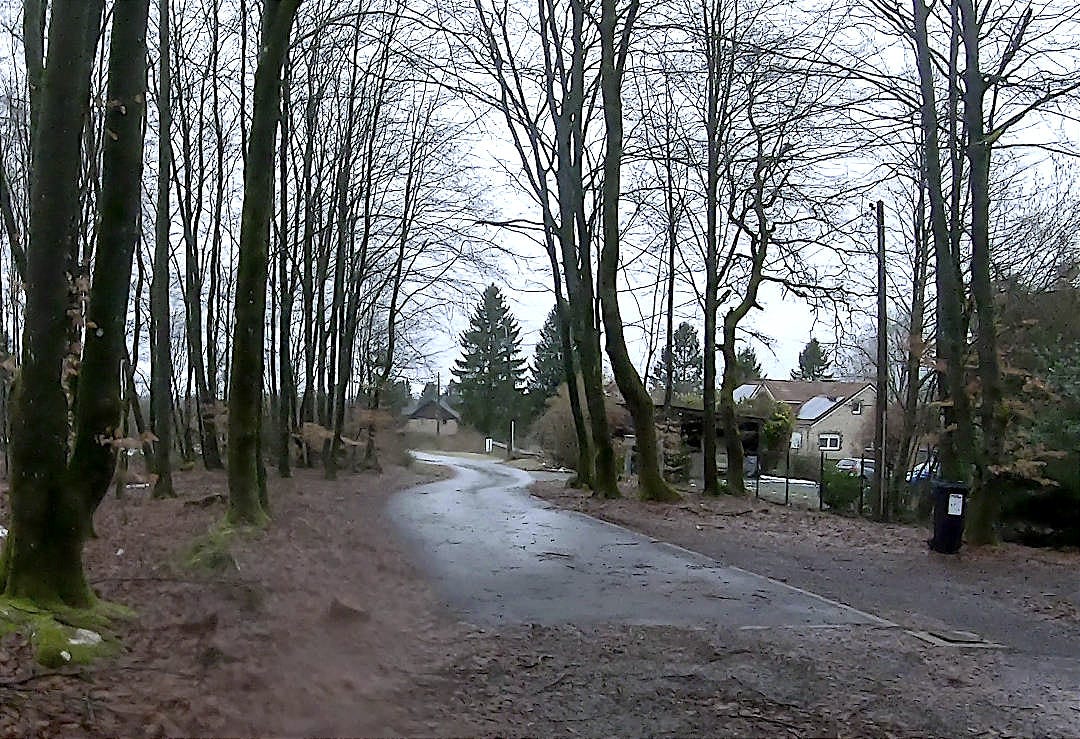
After some hours swimming through swamps, it was a great feeling to be back running on tarmac again. A few pedestrians shot glances in my direction, probably wondering what I thought I was up to running the High Fens in winter. After only a few minutes soaking in the trappings of normal life, the route forked back off into the woods, dropping down into a valley to track the Hoëgne river once again.
Fortunately the river trail was much nicer down here. It rolled over undulations of soil, mud and puddles. Shaded by trees on both sides, I felt quite cosy down here. The route criss-crossed the river over so many wooden bridges that I quickly lost count. There was quite enough to keep the mind engaged: tree root spaghetti, rocky obstacles smoothed by centuries of rushing water, and plenty of trail options.
While using a walking break to let my Achilles recover, I heard the sound of slopping behind me. I shot a glance over my shoulder to spot a runner in full flow - it was Frank!
We ran together, catching up on our journeys since CP3. We’d both struggled with wholly insufficient gear over the exposed plateau, though Frank had adopted a rather more sensible strategy at the tent aid station. Instead of burning his throat and turning hypothermic inside the shower cubicle, he’d popped inside the swanky brasserie, dried himself out and recovered properly.
This difference in our approaches reminded me of my first Spine race, where I’d run past all the optional stops, including that most enticing Tan Hill pub, despite my acute need for warmth and shelter. Aye, there were lessons to be learnt from this first-timer…
Then Frank asked whether I’d heard from Jandalf, which seemed strange - I told him I hadn’t. I didn’t intend to read my messages until the end of the race, I explained. Frank followed up by asking “You know he DNF’d, right?”
Jandalf? DNF’d? I couldn’t believe it. I’d assumed Jan was out in front, leading the race alongside Atomic Barista. Why on earth would he have DNF’d? “He’s in hospital”, Frank explained.
Wait, what - hospital? I yanked out my phone and scrolled through my WhatsApp messages. I stopped on a photo of Jan’s trademark stoic expression. He was lying in a hospital bed, with enough tubes and wires trailing from his body that he looked half man, half machine. “Don’t worry”, Jandalf had written beneath his photo. “RACE!”
Frank and I climbed out of the river valley onto higher ground to the south of Solwaster, where we were joined by two Legends Trail volunteers. We trotted along as a foursome while the safety team grilled us both, like safety teams do, to check we were both physically and mentally OK. After hearing the news about Jandalf I wasn’t in a particularly talkative mood, and I preferred to let Frank handle the pleasantries for us both.
We ran along a road, the Route des Grands Fagnoux, where properties with pristine manicured lawns contrasted with the grittiness of our endeavour. After this the safety team held back, letting us run free once more into the muddy woods and waterlogged valleys of the river Statte.
Frank and I were in two very different places. Frank was flowing freely and eager to press on, whereas I was hobbling, fighting my painful foot, and struggling to keep up with him. It was time for us to part ways. So I slowed my pace while urging Frank on, wishing him a strong race. As pleased as I was for him, his departure left me in a grotty mood, feeling ever so frustrated that I couldn’t participate properly in Legends Trail. Nor could I fulfil stricken Jandalf’s instruction: to RACE.
Darkness fell for the third time, and with it the going got a bit tougher. The ground grew increasingly waterlogged, bearing more of a resemblance to those swamps from earlier. Flowing streams cascaded over rocks that were separated by gritty mud, snow, tufty grass and young trees. The cold water sloshed around inside my supposedly waterproof socks, acting like an anaesthetic that softened my aching feet.


This was growing ever more tedious. The slow progress, the wet ground, the pain, the tiredness. While I was crossing off the kilometres, each one took so long it only exacerbated my mood. I would have to switch something up to get myself back on track.
I committed to refocus; to pick up the pace, and make good time. As I pushed harder I found my gait improved, which reduced the pain, which improved my motivation, which caused me to push harder - a positive feedback loop that was game changing. Now the kilometres tumbled nicely. For the very first time, I pulled out my phone and looked up the race’s cut-off times. I learned that CP4 closed at 4am, and CP5 at 10pm. Given it was half past nine in the evening, that gave me 6 hours and 30 minutes to travel roughly 8km to CP4. I was comfortably ahead of the cut-off, then.
So I started thinking about the 10pm cut-off at CP5. That was 73km from CP4, making it the longest of all the legs. And then the route from CP5 to the finish traversed the gnarly Ninglinspo river, which Eric had warned would be extremely slow going. I remembered he said it might take longer than the 10pm CP5 cut-off allowed. If Eric was correct, then instead of arriving there by 10pm, I would need to aim for earlier - say, 8pm.
I cogitated over what this meant. If, for the sake of argument, I wanted to give myself the opportunity to finish this race, was there time to sleep at CP4 - or ought I just press straight on? Was pressing straight on even an option, given I’d only dozed for 90 minutes at the Bag & Boom, and another 10 minutes on a picnic bench…
My strategic musings stalled around the 200km milestone when my watch brought me to a halt. Its GPS showed that I needed to cross the river right here using a footbridge, yet as I shone my headtorch across the 10 metre span of water, there was no crossing to be seen. And that gushing torrent of water didn’t look friendly.
I ran forwards and backwards along the river to no avail, finally shuffling down to the water’s edge to get a better read of its depth and speed. Down here, feeling my pole instantly torn away by the power of the water, I conceded that it definitely wasn’t a sensible ford.
But what other choice was there? And wasn’t it at least plausible that our Legends route setters might mean for us to cross it? After all, it would hardly be the first dodgy ford they set us.
I lay down on the river’s bank, considering the possibility of attempting a crossing. What were the odds of crossing without falling in? Nil. But if I swam, then what about making it across uninjured? I reckoned I could do it, probably. But the water was moving so damn fast, how far would I travel downstream before I reached the other side?
What frustrated me most was how this was interrupting my flow. I’d been running quite well, and now I was laid out, my muscles cooling, my Achilles tightening.
I pulled out my phone and studied the Strava global heatmap. It looked like people did cross the river, but nobody crossed here at the marked footpath. They crossed a way further back, where there was no footpath.
I thrashed through he undergrowth along the river’s edge and cranked my headtorch beam up to maximum power. In the far distance, I glimpsed a reflection off of a wooden slat. A bridge! I shivered at the realisation that I’d nearly tried to ford such a dangerous, raging river. My judgement needed re-calibrating. Even the Legends route setters wouldn’t have asked us to do that. What had I been thinking?
I finished the last drops of water I’d been rationing, and the last bites of marzipan. That was it, the last of all my supplies. I figured only a couple of kilometres to CP4 remained, though I was really only guessing - I hadn’t loaded checkpoint waymarkers onto my GPS route, like I usually do for races. That I could see a few lights in the far distance was a promising sign.
A field opened up to my left, where I was surprised to see a couple standing in the dark. The man addressed me by name, asking me how I was doing. Feeling confused, I replied abstractly, wondering who these people were and how they knew who I was. But as we talked, I realised that I recognised his face from earlier. I just couldn’t pluck the name or location from memory.
Whoever these two folks were, they seemed really lovely. They wished me well, reassured me there wasn’t much further to go to CP4, and promised to see me at the checkpoint. This gave me a good boost.
The route broke out onto a quiet, dark country road, before forking right, back onto a steep trail climb. The lights I’d seen earlier had disappeared, replaced with solitude, darkness and ascent. I was parched and hungry, hobbling badly, relying heavily on my poles. By my estimations the checkpoint should be right here - but ‘here’ now seemed to be nowhere.
The rural road wrapped around a modest fell, dropping down onto a windy trail. Now I could see those lights again. One of them must be the checkpoint, surely…
Still the watch directed me forward, breaking onto a road, passing properties with blazing lights and warm hearths, while instructing me to run on past them, dropping down into the heart of Polleur. Through the town centre it took me, passing right by establishments that looked like they’d have water, and maybe even marzipan.
Now my GPS route showed a blip, a 20 metre out-and-back. Which could only mean one thing. I trotted up to the Salle des Fêtes de Polleur at a quarter to midnight, just four-and-a-quarter hours before the cut-off.
What I thought I was doing here, I didn’t know. This wasn’t Operation Oolong any more. It wasn’t racing. It wasn’t sensible. It wasn’t anything, really. It just was.
I needed to hydrate. I needed to eat. I needed to change into some dry clothes, though I had none of those. And then, I supposed, I needed to pack some marzipan.
Because that’s one one does at a checkpoint.
One prepares for the next leg.